|
|
|
|
|
|
Note: This report has been scanned in by Ed Sprague. For a collection of Worlds' reports plus photographs contact Ed Sprague ejspraguejr@mac.com to order his book "The San Diego Bay Star Fleet".
A short history of
Star Class World's Championships sailed on the U.S. West Coast, written
for last year's championship program, ended with the conjecture, "Perhaps
1958 begins a new era of West Coast Gold Star supremacy". The writer
of that article became a truer prophet than he knew, at least for one
year, when two Californians, Bill Ficker
and Chick Rollins, finished one-two in the 1958 series. Charles de Wolf Rollins,
who with William Pickford crewing was the 1958 runner-up, had been sailing
Stars for more than twenty years. He started his yachting career in the
original home of the Stars, Western Long Island Sound. The records show
that the first Perseverance, No. 912, was runner-up to Frank Campbell's
Rascal in the 1936 championship of that fleet. Later Rollins moved
to California, where he has been sailing Stars intermittently since World
War II, more
seriously during the past three years. In 1956 he was third in the Fifth
District Blue Star and won the Newport Harbor Fall Gold Cup. In 1957 he
won the Pacific Coast Yachting Association Championship, but failed to
show up well in the North American series. After a strong start in that
event with a second and a fourth he was unable to maintain the pace and
finished the series in eighth place. In 1958, sailing a new Perseverance
(No. 3496, formerly George Fleitz's Wench V), it was a different
story as Rollins put together the best series of his career for an easy
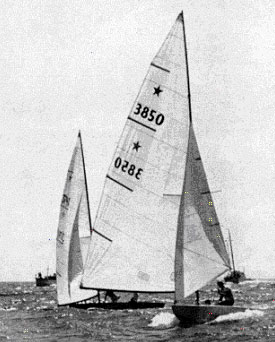
second in the Gold Star event. After four races, barring accidents, Nhycusa had the series won. With two firsts, a second and a third she held a six point lead over Perseverance's 4-5-3-1. It was Ficker's obvious task to cover Rollins in the final race, which he did quite successfully even though it dropped him to tenth place, Rollins finishing twelfth. Both skippers badly overstood the first mark in that race and were unable to recover; but they didn't have to. James M. (Ding) Schoonmaker, from Fishers Island Sound, Florida, sailed his Dingo to series third, partly by virtue of a brilliant finish after a good but undistinguished showing earlier in the week. Dingo entered the last race standing fourth in the point score, one behind Richard Stearns' Chicago entry, Glider. But Schoonmaker found that elusive first mark first (except for Walter von Hütschler, who made a habit of rounding first marks in the lead in this series), and romped on to win the race. Stearns, who finished fifth, had to be content with series fourth. Actually Glider had the most consistent record of all, never finishing below eighth, a feat not matched by any other entry. Fifth in the series was Lowell North's defending champion, North Star III, which staged a fine recovery after her opening disaster and finished 4-2-2-3 in that order in the remaining races. What the series would have been like with North Star a contender is anybody's guess. It is one of the unanswerable "ifs" of the year. Sixth (actually tied with North Star on points) was Charles de Cardenas, whose Kurush V was always in there fighting in weather which was mostly lighter than the double World's Champion likes. Seventh was Joseph
Duplin's 1956 Atlantic Coast Champion Star of the Sea, the boat
that created a sensation at Havana in 1957 when she entered the last race
of the World's Championship one point out of first place and finished
third in the series. Duplin won the second race of the 1958 series and
remained second in the score until after the third race. But in the fourth
race Star of the Sea met disaster when a chainplate pulled out,
leaving the mast wholly without support on the starboard tack. She finished
twenty-second, but only the quick thinking of crew Ross Sherbrook enabled
her to continue in the race at all. Sherbrook tied a line to the dangling
chainplate, let it around and under the outside of the hull, up the port
side and thence to the jib winch where he took a strain and secured it.
It is easy to see, hours later after one has been towed home disabled,
how a breakdown might have been repaired. It is not so easy to appraise
a dangerous situation when every wave threatens to take out the rig, decide
instantly what has to be done, and do it. It was not a spectacular maneuver,
and it saved them only three points and one series place; but it was nevertheless
the outstanding bit of seamanship of the week. The chainplate, including
a gaping hole in the deck, was expertly repaired that night in an incredibly
short space of time by the wizard Eichenlaub. Duplin chalked up a surprisingly
similar record at the North American Championship the following month
when he entered the fourth race third in the standings, hit a mark, and
again wound up series seventh. The San Diego Yacht
Club and the San Diego Bay Fleet put on a fine show. Indicative of the
thought and effort that went into it was the building by the host club
of an entirely new launching and hauling area and the installation of
two electric hoists especially for the event. The boats were not hauled
every night, although they could have been; instead, to make life easier
for the contestants, all the choice slips nearest the yacht club were
vacated by their customary boat owners and turned over to the Stars for
the week. It was especially
appropriate that Glenn Waterhouse, the first winner of the trophy twenty-five
years ago, was on hand to present it to Bill Ficker. Waterhouse spoke
briefly of the origin of the historic cup. At Southport in 1932 Bud Vanderveer,
who had that day won the third race of the World's Championship, was killed
in an automobile accident. Waterhouse and two other Star sailors in the
car were lucky enough to be thrown clear and were not seriously injured.
The next year Glenn Waterhouse won the Gold Star and also the new three-race
trophy, which the Vanderveers gave in memory of their son. The new Champion sails an Eichenlaub boat, which he finished beautifully himself, taking all of the winter of 1956-7 to do so. He used Baxter and Cicero sails in this series, a brand new suit, which he tried out for the first time in the tune-up race just prior to the World's. He liked it so well that he used no other sails during the entire series. Before we leave San
Diego we must give credit to the co-Chairman of the event, Tim Parkman
and Robert Mann, and their assistant Malin Burnham; and to Bill Severance
and his faithful and efficient Race Committee, George Worthington, Paul
G. Smart and Dick Hahn. In addition, every member of the San Diego Yacht
Club deserves the thanks of the Star Class for the co-operation and assistance,
which helped to make the series a success. |
|||||||||||||||||||
|