1943 World Championship - Great South Bay, Long Island, NY
The following results are from George Elder's book "Forty Years Among The Stars". In common with the early Logs it is interesting to note that in his results Elder does not give the yacht numbers of the boats which participated in the World's, but only just their names. It was not until the 1950 Log that yacht numbers were included in the results. From 1950 through 1976 both yacht numbers and names were given, but starting with 1977 frequently only yacht numbers were given. The last time both yacht numbers and yacht names were given was 1989.
In later years sometimes fleet designations were omitted. In these cases some of the more obvious fleet designations were supplied. Also from time to time only last names were supplied. First names, where known, were added.
Abbreviations etc: Dsa - Disabled. Dsq - Disqualified. Dns - Did Not Start.
Wdr - Withdrew. Ch - Chairman. B - Builder. * - Defending Fleet. 0 - No points, reason not given.
1943 - ON GREAT SOUTH BAY (War-Time Skipper Series)
| Skipper | Crew | Fleet |
|
|
|
|
|
Pts. |
| A. Deacon | P. Roehm | W. Long Island Sound |
|
|
|
|
|
79 |
| W. Picken Jr | J. Forrington | Greet South Bay |
|
|
|
|
|
76 |
| C. de Cardenas | G. Carricaburu | Habana |
|
|
|
|
|
74 |
| T. Coe | B. Coe | West Jersey |
|
|
|
|
|
72 |
| H. Halsted | R. Bowden | Moriches Bay |
|
|
|
|
|
69 |
| H. Driscoll | M. Burnham | San Diego Bay |
|
|
|
|
|
67 |
| C. Baker | N. Castle | Lake Ontario, American |
|
|
|
|
|
66 |
| R. Allen | J. Smyth | Newport Harbor |
|
|
|
|
|
64 |
| P. Smart | V. McHugh | C. Long Island Sound |
|
|
|
|
|
47 |
| H. Brown | L. Nelson | South Jersey |
|
|
|
|
|
47 |
| G. Elder | J. Zimmerman | Gravesend Bay |
|
|
|
|
|
46 |
| T. Clark | W. Wilson | S. Long Island Sound |
|
|
|
|
|
43 |
| C. Ulmer | Mrs. Ulmer | East River |
|
|
|
|
|
43 |
| E. Raymond | F. Rich | Wilmette Harbor |
|
|
|
|
|
30 |
| C. Lee | E. Vick | Seneca Lake |
|
|
|
|
|
27 |
| C. Daniel | J. Bolding | U. S. Coast Guard |
|
|
|
|
|
27 |
| H. Clark | Cape Ann |
|
|
|
|
|
26 | |
| C. Shoemaker | M. Kuehne | U. S. Naval Academy |
|
|
|
|
|
16 |
| J. Douglas | L. Stevens | Lake Maracaibo |
|
|
|
|
|
15 |
Best Boat Score: No. 1931, Flying Colors. B - Saybrook Yacht Yards, Saybrook, Connecticut, 1940.
Ch. Meeting - G. W. Elder. Ch. I.R.C. - T. T. Everitt.
Regatta Report from the 1944 Log
DEACON WINNER OF WORLD CHAMPIONSHIP
Arthur M. Deacon and Perry R. Roehm of the Western Long Island Sound Fleet didn't take a single first place or a second place in the world championship skipper series held in August on Great South Bay off the Bay Shore Yacht Club, but they were at all times so close to the top that they amassed enough points to win the Gold Star by three points. In the second place was Bill Picken of Great South Bay while Charles de Cardenas of Habana was a close third.
The skippers drew daily for boats, so that no one had the same craft twice. The better Stars were labelled A boats, the not so good. B boats. On the first day there were two drawings. First was to decide which ten skippers would get A boats and then which A boat they got. Thereafter everyone had two A boats and two B boats, all drawn. For the final day the ten leaders in points drew for the ten boats which had scored most points. Of the group drawing B boats last day, the Ulmers of East River won the special "B" prize. Deacon is reported to be the youngest skipper, but one, to win the Gold Star. His remarkably consistent performance over the five races in the fast company of nineteen excellent entries included two thirds and three fifth places.
 A typical piping Great South Bay southerly provided plenty of action in the opener. The breeze was a good 18 knots before the start, dropped off to 15 and then rose again to 22 in puffs out near Fire Island where the outer mark of the windward leg was placed. It was moist going in the heavy chop and sails were wet but no wetter than the crews. After covering half the course, the mast went out of Flash Too which had been drawn by Bob Allan of the Newport Harbor Fleet.
Blue Stardust, sailed by Midshipmen Shoemaker and Daubin of the Naval Academy, withdrew with a snapped backstay after completing the first round of the twice around wind ward and leeward course. In warming up before the race the Coe brothers of the West Jersey Fleet saw the mast in Horace Havemeyer's Gull, ex Frank Campbell's Rascal, snap off halfway up. A reserve boat, War Hawk ll of Gravesend Bay, was substituted. Clifton Baker of the Lake Ontario American Fleet never did get his jib set and sailed the whole race without one, placing ninth.
That was the type of a day it was and under the circumstances it was to be expected that three of the very foremost heavy weather sailors would show the way. Bill Picken won by a minute over Harold Halsted while Charles de Cardenas was a good third, three minutes back. In that race Picken had drawn Halsted's Chuckle while Halsted had drawn Picken's Fo Fo.
On the second day a light northerly was the cause of a postponement, The wisdom of the Race Committee was proven when eventually the southerly came in. In the meantime, the interlude was put to good advantage to complete repairs of the breakage of the heavy weather of the previous day.
A twice around triangular course totaling 10 1/4 miles was finally set and at the start Paul Smart had all the best of it. He was to weather, with Deacon down to leeward but with his wind free. The windward boats suddenly had a good lift as the breeze freshened and in two tacks Smart was well out in front. Then de Cardenas moved up and on a long tack to the southward worked out a nice lead. Only twice after that was he headed and both times it was by Horace Brown of the South Jersey Fleet, who eventually placed fourth.
At the finish de Cardenas had 31 seconds on Smart, with Deacon in third place 14 seconds back. After this contest the point scoring stood at de Cardenas 36, Smart and Deacon 32, the Coe brothers 28, and Picken and Halsted 26. The latter two had dropped to twelfth and thirteenth, which did not at all help their point standing.
Again, on the third day a different skipper showed the way. This time it was Clifton H. Baker of the Lake Ontario American Fleet. Great South Bay again provided a fine sailing breeze for the twice around triangular course. Paul Smart got away to another of his fine starts and he and Midshipman Shoemaker led the fleet on a broad reach. Some headed for the first mark while others held to the eastward, eventually jibing for the mark and tacking down wind.
It was a close reach to the second turn and a rail-down thrash to weather followed. Baker had four seconds on Deacon at the mark, where the latter made a smart inside turn to forge ahead. Baker soon caught and passed him again. Picken, down in thirteenth place, suddenly got going and he and Baker battled it out in a real dog fight, the Rochester skipper eventually getting the decision by half a minute. The competition was close throughout. Most of the craft were clocked seconds apart and Picken had but two seconds on Harlan Driscoll of San Diego Bay at the finish.
With three races gone it was still a wide open series with the scoring being Deacon 47, de Cardenas 46, Picken 44, Baker 44, Coe 41, Smart 39, Halsted 38 and Driscoll 37.
A dripping wet fresh easterly made for uncomfortable racing in the fourth contest. Four of the boats failed to finish as the soaken wet heavy sails placed unusual demands on rigging and gear. Paul Smart had a good lead at the first mark when two spreaders gave way and he was forced to withdraw. Ted Clark of the new Southern Long Island Sound Fleet was also doing well when he had to withdraw because of a cracked mast. Cadet Charles Daniel of the Coast Guard Academy Fleet withdrew after a shroud parted on the second round and Midshipman C, H. Shoemaker of the Naval Academy dropped out after an accidental foul at a mark.
All in all the weather wasn't fittin' fer humans to be afloat! The fleet sailed into and out of the murk and then soggy wet white sails would loom out of the rain. The breeze was about eleven knots and the course was the twice around windward and leeward variety. Before the start Cliff Baker, in attempting a tight squeeze, had the rudder of his Star catch the anchor rope of the Race Committee boat under water. He went overboard, freed his craft and carried on a minute and a half after the others to finish eleventh. He was no wetter than the others despite his submersion.
After Smart had to drop out, the Coe brothers took the lead and at the end of the first round had a two second margin on de Cardenas, with Bob Allan of Newport Harbor third, Picken fourth and Deacon fifth.
At the start of the second round de Cardenas really started to move and he worked out to a lead of a minute and a half at the finish over Allan. Coe was third, 35 seconds back and he had about a minute on Bill Picken. Deacon, who had been last at the first mark was in fifth place. With but one more race to be sailed the point leaders were: de Cardenas 65, Deacon 62, Picken 60, Coe 58, Baker 53, Halsted 51, Allan 49 and Driscoll 48.
For the finale the three times around triangular course was set. At the start the wind was easterly and good for about twelve miles. By the time the fleet was half way around the second lap the wind had shifted to south east and had slackened a trifle. The skippers had plenty of windward work throughout. Deacon led at the end of the first and second laps. On the final leg. as the leaders approached the finish line, Deacon ran into a soft spot and was barely nosed out of second place by Halsted who was clocked three seconds behind Harlan Driscoll of San Diego.
That third place was more than enough to give Deacon the series title, however, as the summary will show, Picken's fourth place netted him the runner-up spot in series point scoring while de Cardenas dropped from his lead to a series third by reason of his eleventh position in the finale.
What with war time difficulties of transportation, gas rationing, food rationing and the pressure everyone was under, it was a remarkable series. The Race Committee fortunately had no protests to rule on and, headed by Chairman Ted Everitt, did an outstanding job. The boisterous breezes and consequent damage to boats did not make things any easier for them.
Assisting Everitt, who was everywhere at the right moment, were Lieut. W. C. (Jack) Wood of the U. S. Coast Guard, Merrill Foot and Harold Pearson of Great South Bay and Edward Bungue of Gravesend Bay. Jack Wood and the Coast Guard were especially helpful in their tireless repair efforts and getting the yachts to and from "Picken's Creek".
From the shore dinner Monday night to the final banquet Saturday night, both at the Bay Shore Yacht Club, and at the innumerable cocktail parties in between, there was the traditional Star Class hospitality in the best Great South Bay version. Under the pressure of war conditions skip pers, crews, and visitors were drawn together in a most congenial cooperation. Never were roaring fires so much appreciated by a host of drenched sailors as they were on that Friday night after the fourth race when all hands were drenched to the skin, cold, and blue. In the club and the hotels and homes about town they were greeted as they came ashore by crackling fires that soon dried them out, and hotel banquet rooms were made available for the drying of the sails without which the next day's race finale would have been impossible.
The system of drawing for boats worked well and everyone had an equal opportunity. The series did show that sailing a different boat each day put a premium on adaptability, as even the best of the skippers, used to their own boat's gadgets, had difficulty adjusting themselves to the type used by another builder on the craft they were sailing on the various days.
The Invader's Trophy was won by J. C. Douglas of the Lake Maracaibo, Venezuela, Fleet. The Distant Fleet Trophy went to Harlan Driscoll of San Diego Bay, while Horace Brown of the South Jersey Fleet went home with the First Challenge Trophy.
1943 WORLD CHAMPIONSHIP SKIPPER SERIES STATISTICS
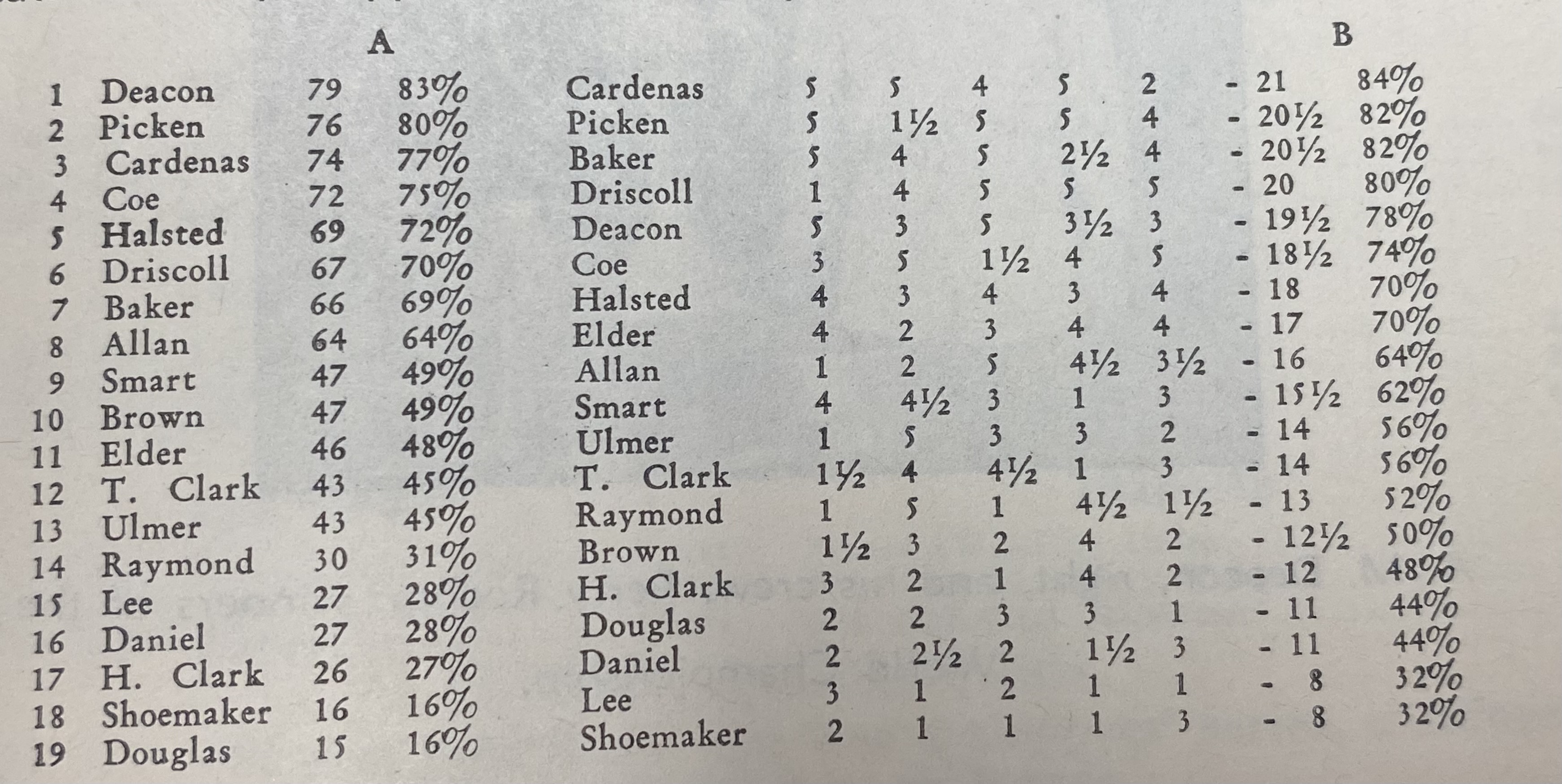
COLUMN A shows the official points and percentages of the 1943 World's Championship, which are repeated for convenient reference,
COLUMN B is a theoretical round robin between each skipper and all other skippers who sailed the same five boats that he did, figured on the usual 5, 4, 3, 2, 1 basis. If a 5 appears in the first column, it means that he did better with the first boat he sailed than anyone else, a 1 means he did worse than anyone else, a 12 indicates a tie. Total points and per centages are shown in the last two columns.
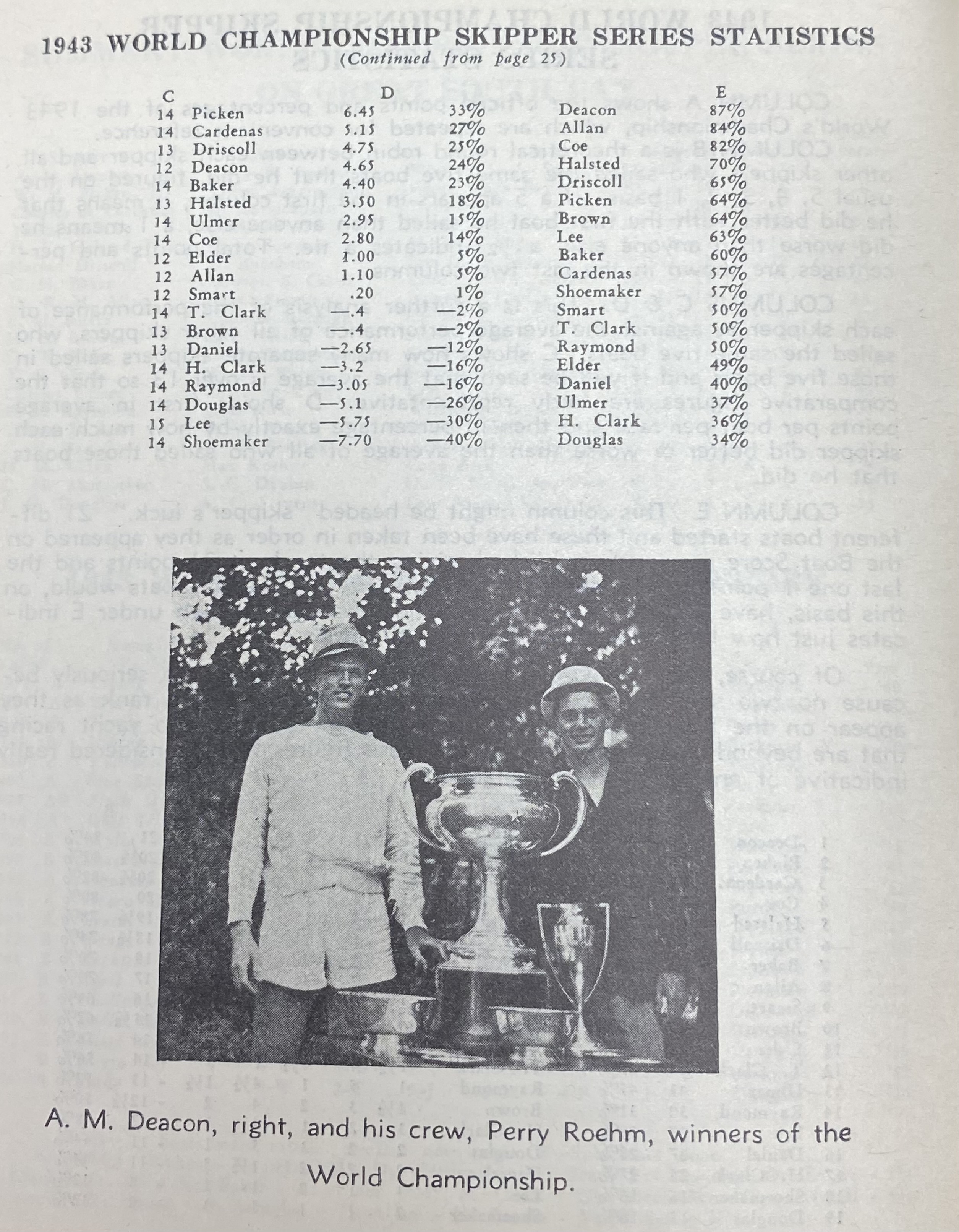
COLUMNS C & D. This is a further analysis of the performance of each skipper as against the average performance of all other skippers, who sailed the same five boats. C shows how many separate skippers sailed in those five boats and it will be seen that the average is over 13 so that the comparative figures are fairly representative. D shows first in average points per boat per race and then in percentage exactly by how much each skipper did better or worse than the average of all who sailed those boats that he did.
COLUMN E. This column might be headed "skipper's luck." 21 different boats started and these have been taken in order as they appeared on the Boat Score previously published, giving the top boat 21 points and the last one I point. A skipper having drawn the five highest boats would, on this basis, have 95 points or 100%. The percentage shown under E indicates just how lucky the skipper was in the draw.
Of course, the following figures must not be taken too seriously because no two skippers would agree that the boats actually rank as they appear on the Boat Score and too many elements enter into yacht racing that are beyond a skipper's control for these figures to be considered really indicative of any skipper's actual ability.