1964 World Championship - Boston Harbor
The following results are from the Star Logs. In common with the early Logs from 1950 through 1976 both yacht numbers and names were given but starting with 1977 frequently only yacht numbers were given. The last time both yacht numbers and yacht names were given was 1989. In later years sometimes fleet designations were omitted. In these cases, some of the more obvious fleet designations were supplied. Also, from time to time only last names were supplied. First names, where known, were added.
Results
No.   Yacht		Skipper		Crew		Fleet		Daily Places		Pts.

4489  Big Daddy		Don K. Edler	Kent Edler	Newport Harbor	 1   2   3   6   6	262

4836  Star of the Sea	Joseph Duplin	Francis Dolan	Boston Harbor	 2   7  13   3   1	254

4749  Chatterbox		Malin Burnham	C. Lewsadder	Fifth District	16   1   1   5   3	254

4887  Turmoil		Gary Comer	William Bennett	S. L. Michigan	 7  25   2   1   5	240

4831  Mache		Donald Bever	J. Sharpnack	S. Lake Erie	 3   9  28   4  10	226

4734  Tranquilizer	John Bennett	Mickey Shanahan	Mission Bay	 5  15   9  23   2	226

4799  Cirrus		H. Lippincott	Tupper Hale	Second District	26   3   8  15   7	221

4825  Shanachie		E. W. Etchells	Anson Beard Jr	CLIS		10  10   5  26  11	218

4733  North Star		Lowell North	Barton Beek	San Diego Bay	 6  11  21  13  13	217

4790  Creepy III		Foster Clarke	Gerald Donovan	Coral Harbour	 4  12   6  14  28	216

4646  Bergerac		Joseph Burbeck	Nick Orr	Great South Bay	13  14  24  10   4	215

4525  Puck IV		Gerd Fischer	Dirk Springorum	Hamburg		12  17   7  16  18	210

4798  Blade		R. Lippincott	Walter Flynn	West Jersey	 8   8  18  17  19	210

3130  October		Gene McCarthy	Carl F.Morey	Jackson Park	11  19  19   7  17	207

4840  Desiree		Herbert Hild	James Egan	First District	24  22  11   8   9	206

4813  Blott VII		Sig Wennerstrom	Bernt Larsson	Vinga		15   5   4  27  30	199

4754  Tackless		John Goddard	Paul Woodbury	Cape Ann	 9   6  14  31  31	189

4802  Big Blue		Richard Stearns	Robert Halperin	Wilmette Harbor	28   4  wdr  2  14	176

4141  Magic		Robert Rodgers	Allan MacKay	Green Lake	19  30  15  11  37	168

4898  Lucky Liz II	Fritz Riess	Eberhard HoeniglBayricshes Meer	17  36  25  29  12	161

4648  Flapper		W. Shehan	Tom Stevens	Eastern Shore	18  47  12  25  20	158

3940  Flame		C. S. Ogilvy	Peter Levinson	WLIS		23  21  35  18  25	158

4859  Wolf II		Robert Wilson	Robert Sexauer	East River	14  46  22  24  22	152

4330  Pirate		Jack Stewart	Dan Lee		Ithaca		53  13  10  45   8	151

4459  Super Rat		Read Ruggles	David Dickey	Biscayne Bay	37  16  16  34  26	151

4812  Crackerjack	A. Jaretzki III	A. Jaretzki IV	Otsego Lake	25  18  39   9  38	151

4888  Pink Lady		Robert O'Neil	Jerome Leterman	Chicago Harbor	20  20  27  40  29	144

4222  Snow Goose		W. Castle Jr	Robert Castle	Lake Ontario, A	35  39  33  21  21	131

4675  Vengeance		Wm. Gentzlinger	W. Blackman	Huntington Bay	21  wdr 20  28  27	128

4855  Scotch		Thomas Hislop	Asa Colson	Owasco Lake	34  dns 23  19  24	124

4881  Jan		Florus Black	Robert Black	St. Joseph	44  26  26  37  23	124

4597  Tijuca		C. W. Lyon Jr	Frank Lyon	Atlantic H.	27  23  dnf 12  46	120

3081  Mate		Willard Hodges	David V. Black	Lake Sunapee	33  31  32  22  45	116

4548  Chuckle		Harold Halsted	Peter Rankin	Bellport Bay	50  28  31  41  15	115

4558  Blue Chip II	David Gaillard	Harvey Lekson	Chesapeake Bay	42  27  41  20  36	114

4340  Aquarius		Mead Batchelor	William Sumner	Mid-Connecticut	41  24  17  30  dnf	112

4144  Finale		Richard Miller	Joseph L.Ehle	Cleveland Hbr.	31  33  40  39  35	102

4844  Finesse		Michael Flynn	G. Flynn	ELIS		30  32  30  36  wdr	 96

4843  Lynx		Ernest Hanmer	Lois K. Hanmer	Cent. Lake Erie	40  34  38  38  34	 96

4907  White Star		Max Kastinger	H. Kastinger	Attersee	36  35  46  35  33	 95

4046  Surprise		Jack T. Rickard	Mark Swartout	Lake Springfield43  dnf 34  33  32	 82

4400  Warhawk IV		William Seaman	W. Brandstatter	Lake Hopatcong	39  45  43  32  44	 77

4756  Daemon		Dave Millar	P. van Buskirk	Lake Ontario, C	38  29  dsq 42  39	 76

4903  Candide		Albert Debarge	J. de Bokay	Paris		47  38  29  wdr 41	 69

4602  Alvo		Charles H. Dole	William Froome	Kaneohe		49  41  dnf 49  16	 69

4589  Cirrus		P. Sullivan Jr	E. C. Mosmann	Greenwood Lake	32  37  42  46  wdr	 67

3375  Northern Light	Michael Purtell	Wade Badger	Peconic Bay	22  dns 50  44  45	 63

3784  Caramba		William Kieser	Carolyn Kieser	Carter Lake	46  43  37  50  48	 56

4299  Wham Bam II	C. McCormick	John McCormick	No. Ches Bay	51  48  44  43  40	 54

4563  Bobolink II	Edward Braddock	L. Nelson Jr	Barnegat Bay	48  40  45  51  43	 53

3879  Patricia		R. Hutchinson	R. Hutchinson	Paw Paw Lake	45  51  48  47  47	 53

4604  Astronaut		Ralph W. Earl	Susan Earl	Lake George	54  44  36  48  wdr	 42

1939  Gee Whiz		Stephen Warren	Anne C. Warren	Narragansett B.	52  50  48  52  49	 29

4740  Sunba		David Miller	William Mahy	English Bay	29  dsa dns dns dns	 27

3354  Scamper		Rob McGoldrick	Kenneth Adams	Lake Wickaboag	55  49  49  dsa dns	 15
Regatta Report
from the 1965 star Class Log
The 1964 World's Championship was sailed out of Boston Harbor on the waters of Massachusetts Bay, but not from the city of Boston. Winthrop, a town barely five minutes from busy Logan Airport and 20 minutes from downtown Boston, is quite another place. It is doubtful whether anyone in Boston knew the series was going on. Everyone in Winthrop did. The whole town was interested, and the whole town contributed, from the youngest boat-boy, one of whom was assigned to each boat, to the oldest of the town officials who saw to it that the police, fire department, and everyone else who could possibly assist was alerted and did assist.
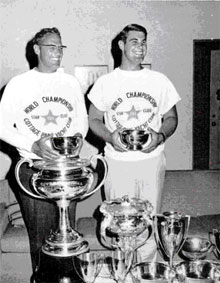
Don and Kent Edler
At the Cottage Park Yacht Club all other activities were suspended for the week as the membership cordially welcomed 110 Star sailors and submitted with good grace to being deprived of their parking lot, their docking space, and most of their other facilities. Although 55 boats is not a record entry list it is big enough to make the series management a major project for the host fleet. We tend to forget that prior to 1962 that number had been exceeded only once.
Measuring, rigging and launching of all boats was completed by 3 p.m. of the day before the first race. An unusually subdued annual meeting forwarded all the proposed amendments to the membership for vote after brief discussion of each. The meeting was followed by a parade to the high school stadium, where the opening ceremonies and flag raising were attended by a huge audience of local well-wishers. Bands played, speeches were made (by everybody including Massachusetts' Governor Peabody) and the week was declared officially open.
The day of the first race proved to be a disappointment as heavy fog blanketed the whole coastal region. The fleet sailed out to the starting area and milled around for a couple of hours, but it was no use. Visibility would improve slightly and then shut down again so that it was impossible to see one end of the starting line from the other, and eventually operations were cancelled for the day.
First Race
The next day dawned no different. The same weather pattern prevailed and looked as if it might remain indefinitely. People were reminded of Portugal in 1962, when it took two and a half days to get the series started. The Coast Guard advised that there was still fog outside, and that the fleet might as well stay in the anchorage, which it did. But better things were in store. Around noon the visibility improved, everybody made the long trek out to the line, and a race finally got under way.
The immensely long line favored the flag end slightly but not enough to create a jam there, and the fleet got away in good shape. Foster Clarke of Nassau was recalled, and as a result was forced to elect the unpopular port tack to get clear after restarting. At this moment Clarke must have felt that it just wasn't his week. Two days earlier the only serious mishap of the whole event had occurred when his boat was on the hoist. A defective sling broke, dropping the Creepy against the pilings, demolishing her rig and tearing holes in her bottom. Clarke refused the offer of a substitute boat, working night and day to get his own back into shape. And here he was making what amounted to a last start in the opening race. Maybe he should have stayed in Nassau?
No, he shouldn't. Odd things happened in this race, one of which was that the starboard tack, which the local experts thought would have less adverse current, failed to work out. An offshore shift favored Clarke's contingent and he actually finished the race fourth, an excellent showing in this week of ups and downs. The leader at the first mark was Lake Otsego's entry, sailed by the Jaretskis, father and son. They took Crackerjack all the way to the port lay line, tacked, and fetched the mark, just ahead of Mason Shehan's Flapper. Third to round was Skip Etchells, then Joe Burbeck, then Malin Burnham.
And where was that other father and son combination, aboard Big Daddy? Not in the first five yet, but it didn't take them long to get there. The light easterly wind was still laden with fog, and in their search for the second mark the Jaretzkis and others led the fleet too low. Burnham found it first, edged slowly higher without giving away his information, and finally made a dash for it that brought him around first. At about the time most of the fleet were taking down whisker poles and trimming sheets the wind came forward a point or so, leaving the most leeward boats in very poor shape. Crackerjack actually had to tack to round what a few moments earlier had been a leeward mark. At the home mark Shehan and Etchells were still in the first five, and now so were the Edlers, with another round yet to be sailed.
How could anybody drop from first to sixteenth in a single windward-leeward round ? It was easy that day. In the first place there were shifts invisible because of the fog. You could never tell how the boats out on the other tack were faring. Then too, today as every day in this series, the whole fleet was so closely bunched that a small error could easily cause the loss of ten boats in scarcely more than ten seconds. The port tack was now the long one, almost fetching the mark. But just when you took that little starboard hitch made all the difference: to be caught too far out to sea on the final approach to the mark was fatal.
Big Daddyrounded first and held the lead to the finish. A closely spaced group containing Chatterbox elected to go low on the last leg, a very broad reach. But the wind dropped and came ahead, the new breeze reaching the leeward boats last. Duplin, the defender, came from 16th at the first mark and 8th at the end of the first round to finish second; and Don Bever of Cleveland, 10th at the home mark, was third. After this race people came ashore muttering about the mysteries of Massachusetts Bay and wondering whether all the races would be as hard to sail as the first.
Second Race
The second day showed considerable improvement, with more stable conditions throughout. The weather was overcast but not foggy. The 10 to 12 mile southwest wind occasioned a long run to the offshore starting area and an even longer beat home afterward. The race started on time with a couple of recalls at each end of the usual long line. Burnham had the start at the flag end, stood on for a few minutes, tacked, and easily crossed the fleet. That happened to be the correct formula for the first leg: those who went inshore after the start had the worst of it.
The reach and run were uneventful and the second time up was more or less like the first. The Edlers, first around the first two marks, were passed on the run by Burnham, who this time held his lead through the second round to the finish. Howard Lippincott's third was his best showing of the week, and Dick Stearns came to life after a disastrous 28th in the opener to finish fourth.
In this race it was Chicago's Gary Comer who saw his hopes dashed. Destined to finish among the leaders in all the other races, his 25th today held him down to series fourth still an enviable position, of course, in a fleet of 55 of the best. So it was each day: some one of the leaders (always excepting Edler) found a wrong place to go and went there. Yet those who had sailed at Chicago at the 1963 World's said that by comparison this one was less fluky. The shifts were smaller and easier to overcome in 1964, and most of the best boats ended up at the top most of the time.
Another comment of those who had attended both series was that in 1963 there were certain boats that would disappear up ahead day after day, never to be seen again. In 1964 the competition was much closer. No one group had any visible superiority in boat speed. The winners won by small margins and were only very slightly faster than the losers.
Third Race
The third race, sailed on what had originally been scheduled as rest day, was moved up to a morning start to accommodate previously planned afternoon events at the Massachusetts Institute of Technology in Cambridge. The wind was light to medium northwest, putting the windward mark well up under the Revere shore. Those who stood in on starboard tack toward Winthrop picked up a lift under the beach, with better air, that carried them up to the mark first.
At the weather mark yesterday there had been a kindly windward set to the current, making it easy to squeeze around the mark. Today the opposite was true and many had trouble rounding. Stearns withdrew after touching it. A triple collision involving Duplin, North and Millar, as all tried to round simultaneously, resulted in the ultimate disqualification of Millar.
There was no stopping Burnham. This time he led at all the marks, and although always hotly pursued by Comer's Turmoil, Chatterbox still had the lead at the finish by a scant five seconds. Big Daddy was third, to take the Vanderveer Trophy for leading at the end of three races by the substantial margin of 12 points. Stig Wennerstrom's Swedish entry was fourth, and after her fifth of the day before was well up in the series standings. But Burnham, having repeated his last year's performance with two daily firsts, stood second over all. Duplin was third.
Fourth Race
The forecast for today was a 10 to 20 mile northerly; what turned up was 5 to 8 from the south. Again the line was far away, off Nahant. A start was attempted on schedule at 1:30, but the line was bad and an immense jam began to develop at the flag end. About half a minute before starting time the postponement signal went up and the line was reset. On the next attempt, on a square line, only one boat was recalled at the flag end.
The fleet split immediately with North and Burnham out to sea (southeast) and Edler in toward shore (southwest). Edler soon saw the error in this maneouver and took a long starboard tack across the entire course to get with the leaders even though he knew it would bring him in behind them.
Bever did very well on the first round, but so did Comer, who ultimately brought Turmoil home the winner. Stearns showed what he could do even in a borrowed boat by taking second, and Duplin's third moved him two points ahead of Burnham for second in the series standing. But Edler, by finishing immediately behind Burnham, dropped only one point of his big lead.
Fifth Race
On the final day the fleet drifted out to the now familiar starting area off Nahant Neck in the last of a dying northerly. In the ensuing half hour's flat calm all eyes were turned confidently toward the south in expectation of the usual afternoon southwester. Then suddenly the wind came back from the north stayed there, and continued to build up until some of the puffs late in the race were the strongest of the entire week.
After the start the majority favored the starboard tack toward the Winthrop shore, a decision based on the third race, the only other northwester. A small contingent consisting of Bennett, Jack Stewart of Ithaca, the Bavarian Fritz Riess, and Joe Burbeck went the other way, and rounded first, in approximately that order. Then came the leaders from the other side of the course, including Edler in about 10th place. Bennett continued to lead for most of the race, but Comer, Burnham and Duplin all went fast offwind and gained places on the reaches. The second time up Duplin closed on Bennett, and Edler moved up to sixth, a position he held at the start of the final run home.
Perhaps you would have thought that 11 points going into the last race of almost any series was a safe lead, but all experts know that overconfidence is dangerous. Uneasy rests the head that almost wears the crown; and Don Edler later confessed to a restless night before the last race. He kept having a recurring nightmare in which Big Daddy was passed by dozens of boats just before the finish line.
A U.S. Navy destroyer-escort had been standing by, discreetly out of the way, all week. As the series was about to end this ship edged in very close to the finish line to watch the proceedings. She was to leeward, of course; but such a big hull, combined with the many spectator boats crowding around, set up a wall that effectively stopped the wind and even created a back-draught. Big Daddy, approaching the finish line safely in 6th place and with only a few yards to go, ran into this dead area together with all the boats ahead. Those behind closed rapidly, and Edler wondered whether his nightmare were coming true. In the last hundred yards there was running, reaching, windward work, running again, for the frantic leaders. Luckily the wind found enough strength to waft everybody across the line, jammed together to be sure but maintaining substantially their original order.
Duplin's win of the last race gave him runner-up position over Malin Burnham in a tie score and cut Edler's lead to six points.
Don and son Kent Edler were runners-up in the 1960 World's at Rio. The next year they acquired the boat with which they have won the 1964 Gold Star. It is modern, of course, with all first-class equipment, but rather standard and lacking some of the special devices added by the more gadget-minded skippers. Edler is not a boat builder or a sailmaker or a specialist in any of the other marine lines that some people think contribute toward making good skippers better. At the World's he measured in only one suit of sails, made by a local sailmaker at his home port of Newport Harbor.
At the final banquet at the Sheraton Plaza Hotel in Boston the other award winners included Pete Bennett, who took the Distant Fleet trophy for that entry from more than 1,000 miles' distance not in the first three series places. The First Challenge went to the Vinga Fleet of Sweden on Stig Wennerstrom's performance. A special sportsmanship award was presented to Max Kastinger. The Cottage Park Yacht Club and the Boston Harbor Fleet donated a gold medal for an Invader's Trophy. To be known as the Kennedy Memorial Medal, it will go to that skipper from a land outside the host country who finishes highest in the standings exclusive of the first three. The recipient of the charter award of this new prize was Foster Clarke of Nassau.
After the 1965 series in California, the World's Championship will have been held three times running in the United States and must, according to the Class rules, leave the continent. Fleet point totals accumulated over the past two years plus those earned at the 1965 World's will determine the location of next year's event if the series this year is won by a North American. The Hamburg Fleet in Germany is the only fleet outside North America to have sent representatives to both 1963 and 1964 World's. Inasmuch as they did creditably in both those events, Hamburg has an imposing lead with 434 points to 230 for Capri. Two other Italian fleets and Moscow are the only others in the 200's. To close the gap of 204 points in five races would require a fleet of at least 41 boats. If this year's event does not draw that many entries, the 1966 World's must go to Germany unless the 1965 Gold Star is won outright by someone else from outside North America.